CW: In order to properly recap the myth sexual assault is lightly mentioned on in the first paragraph.
In Greek myth Medusa was a Phorcydes, one of Phorkys and Keto’s many children. She was a triplet with her two sisters, Stheno and Euryale, and had siblings which ranged from dragons to sea nymphs. She became the monster she is now after being … ‘unwillingly taken’ by Posiden in a temple to Athena. Since Athena is one of the gods of virginity, this defiled the temple and, since she couldn’t get revenge on Posiden, she either cursed/blessed (depending on the version of the myth) medusa with her pertrifying gaze.
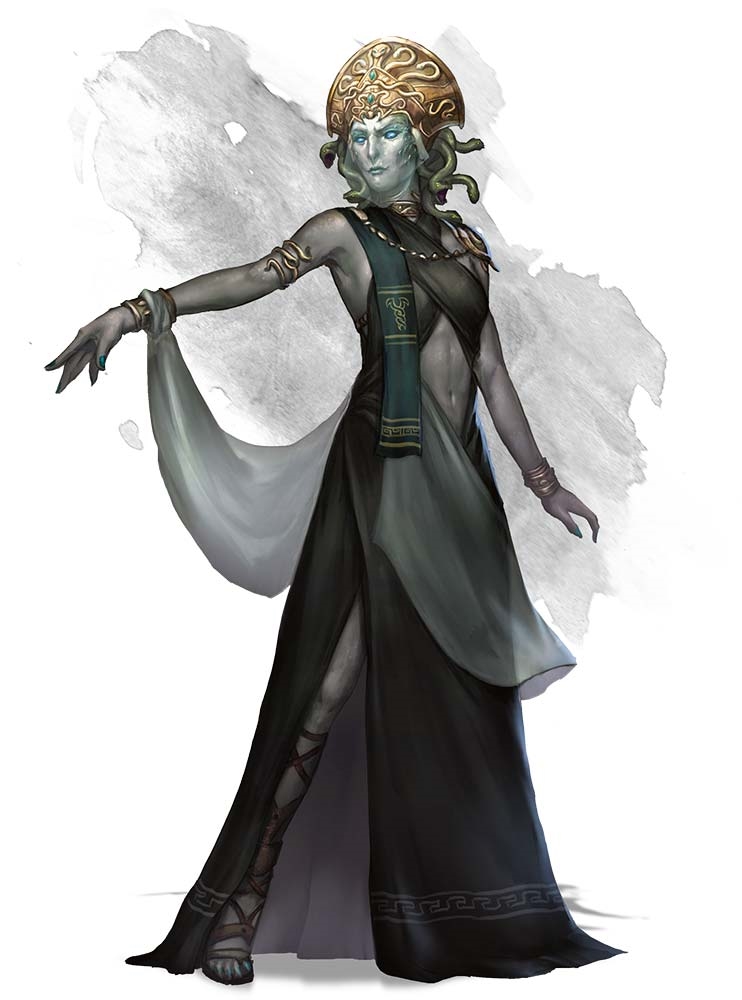
Medusa are one of those monsters that all almost players coming to your table will know. These snake haired ladies are just as ubiquitous as werewolves or vampires in our public conciousness. If you walk past an oldly realistic statue of a man, its almost guaranteed that you’re going to fight one. It is also extremely easy to subvert the medusa’s cliches. We can swap stone for any material really, I’ve used ice and metal, and D&D explicitily says that there are male medusa. As soon as that first statue has been found every veiled woman is an immediate suspect, while a hooded man will sound fewer alarm bells.
In combat oriented RPGs like D&D 5e medusas are a fantastic ‘benchmark’ monster. Its my go to creature if I want to test my PCs as they exit the low levels of adventuring (levels 1-4) and start to become proper heroes (level 5-10).
It has everything you need to test players. A strong ability that is easy to counter by deadly if you’re not ready. A famous lineage so all the players feel like true heroes while they fight it. And an iconic persona, just say the name and people evoke images of Harryhausen stop-motion dragging itself around or a snake haired Uma Therman chasing some teenagers.
All of this is great, but unfortunately leaves medusas with a very gimmicky feel. So, lets make a better monster.
Statistics and Math.
Your average medusa is a CR 6, lawful evil, monstrosity with 15 AC, 127 HP, 30ft speed, 60ft darkvision, and three attacks. A snake bite (+5 to-hit, 18 damage), a shortsword (+5 to-hit, 5 damage), and a longbow (+5 to hit, 13 damage). Otherwise they only have one ability of note and that’s their petrifying gaze.
If a creature starts its turn within 30 feet of the medusa and CAN see her eyes, they have to make a DC 14 con save. If they fail they become restrained for a turn and make a second save next turn, turning to stone on a failure, and then a third save on the next turn either ends the effect or makes it permanent. If they fail the save by 5 or more they instantly turn to stone permanently.
The ability also gives rules on how PCs can avert their eyes, not specifying but implying that the medusa is essentially invisible to them while they do. And it specifies that the medusa can be affected by this ability too.
Honestly, its not a bad package of abilities but it leaves me wanting. Against a party of level 4’s, which is where I’d put her as a boss, her 15 AC says that she’ll be hit around 55-60% of the time, a good number, and take about 12 damage per hit. In a 4 person party that’s about 26 damage a round, which means we expect her to survive or 4-5 rounds of combat.
Round 1. PCs start more than 30ft away so no gaze attack. Open with two longbow shots from her multiattack. Those deal an average of 17 ((13x(.45+.5x(1-.45)))= 8.7, twice) damage, assuming AC 17 and no poison resistance. Retreat to 40ft from party if they look like mostly melee fighters or advance to within 25ft if they look like mostly casters/ranged.
Round 2. Petrifying Gaze affects ~2 PCs. Con proficient PCs will have a 55% chance of resisting and 20% chance of turning straight to stone, non-con proficient PCs have a 45% chance of resisting and a 30% chance of turning straight to stone, assuming +2 con bonus. Things are not looking great for the rogue/hexblade. She then uses her melee attacks to deal an average of 18 ((18x(.45+.5x(1-.45)))=12.1 plus (5x(.45+.5x(1-.45)))=3.3, twice) damage, assuming AC 17 and no poison resistance.
Rounds 3 onwards. Repeat round 2.
This, is booooorrrring. The medusa has no real interaction with the environment aside from distance and no real way of doing anything while the PCs are looking away. If they’re doing that, because they have disadvantage, the fight will be a lot longer. The upside is that our damage is pretty well perfect. Your average level 4 character has 31 hit points, so dealing a little over half each round is a good number.
What then can we do to make the fight more interesting? Let’s give her a recharging attack and make a varient.

New Ability.
Since we don’t want to change the medusas damage this new abilty should be used to the shape the battlefield and reposition herself. Since her lair is likely filled with statues of previous victims lets use those to create some obstacles. To ensure we don’t use it every turn we’ll make them lair actions.
Lair Actions.
On initiative count 20 (losing initiative ties), the medusa takes a lair action to cause one of the following effects; the medusa can’t use the same effect two rounds in a row:
– The medusa calls up a statue to grab hold of one creature within 60 feet of her. The statue attempts to grapple the target and freezes back in place around them. The statue shares its statistics with the medusa, except that it only has 10 AC and 5 HP. Once a creature escapes the grapple or its HP is reduced to 0 the statue crumbles to dust.
– The medusa calls up a slithering carpet of snakes in a 20 foot cube around her. This area becomes difficult terrain until the start of the end of the next round. If a creature is prone within this difficult terrain they must make a DC 14 Constitution saving throw, becoming poisoned and taking 2 (1d4) poison damage on a failed save.
Varient
Taking inspiration from Medusa’s aquatic parentage I decided to make an aquatic varient. It was difficult to decide which aquatic animal to use but looking through the family tree I found Scylla. Upper body of a woman, snapping serpent heads and writhing tentacles. So I made the Scylik Medusa, a with an octopuses lower body and electric eels for hair.
___
Scylik Medusa
large monstrosity, chaotic evil
Armor Class 14 (Natural Armor)
Hit Points 127 (17d8 + 51)
Speed 10 ft. Swim 50 ft.
STR 10 (+0) DEX 15 (+2) CON 16 (+3) INT 12 (+1) WIS 13 (+1) CHA 15 (+2)
Skills Deception +5, Insight +4, Perception +4, Stealth +5
Senses Darkvision 60 ft., Passive Perception 14
Languages Common
Challenge 5 (1,800 XP)
Proficiency Bonus +3
Hold Breath. The medusa can hold its breath out of water for 1 hour.
Water Breathing. The medusa can breathe only underwater.
Actions
Multiattack. The medusa makes either three melee attacks–one with its snake hair and two with its shortsword–or two ranged attacks with its longbow.
Eel Hair. Melee Weapon Attack: +5 to hit, reach 5 ft., one creature. Hit: 4 (1d4 + 2) piercing damage plus 10 (3d6) lightning damage.
Shortsword. Melee Weapon Attack: +5 to hit, reach 5 ft., one target. Hit: 5 (1d6 + 2) piercing damage plus 2 (1d4) lightning damage.
Bonus Actions
Petrifying Ink (Recharge 6). As a bonus action, the medusa can surround itself in a 30ft radius sphere of ink. The sphere spreads around corners and its area is heavily obscured. Starts its turn within this sphere, must make a DC 14 Constitution saving throw. If the saving throw fails by 5 or more, the creature is instantly petrified. Otherwise, a creature that fails the save begins to turn to stone and is restrained. The restrained creature must repeat the saving throw at the end of its next turn, becoming petrified on a failure or ending the effect on a success. A creature petrified by this affect is transformed into pearl white shell. The petrification lasts until the creature is freed by the greater restoration spell or other magic.
If the medusa begins its turn inside the sphere, it is affected by the petrifying ink.


Leave a Reply