Over my years reading and writing adventures for roleplaying games the one issue I’ve seen crop up the most is “how do we balance encounters?”
In D&D 5th edition we use Challenge Ratings (CR) and have a pool of experience that we can spend to make encounters trivial, easy, medium, hard, or deadly. For example a CR 1/2 creature is worth 100xp and a party of 4 level 16 characters will find any fight worth less than 12,800xp easy.
But how does this play out at the table? A group of 4 level 16 characters enter a room and are attacked by 8 shadows, a CR 1/2 monster. According to the Dungeon Masters Guide, 8 monsters multiply their XP total by 2.5. Meaning that this encounter is worth 2,000xp.
2,000xp! That’s such an easy fight that the rules suggest the players shouldn’t even use up any resources to win it! Anyway, I ran this encounter in an Adventurers League game and killed my entire party.
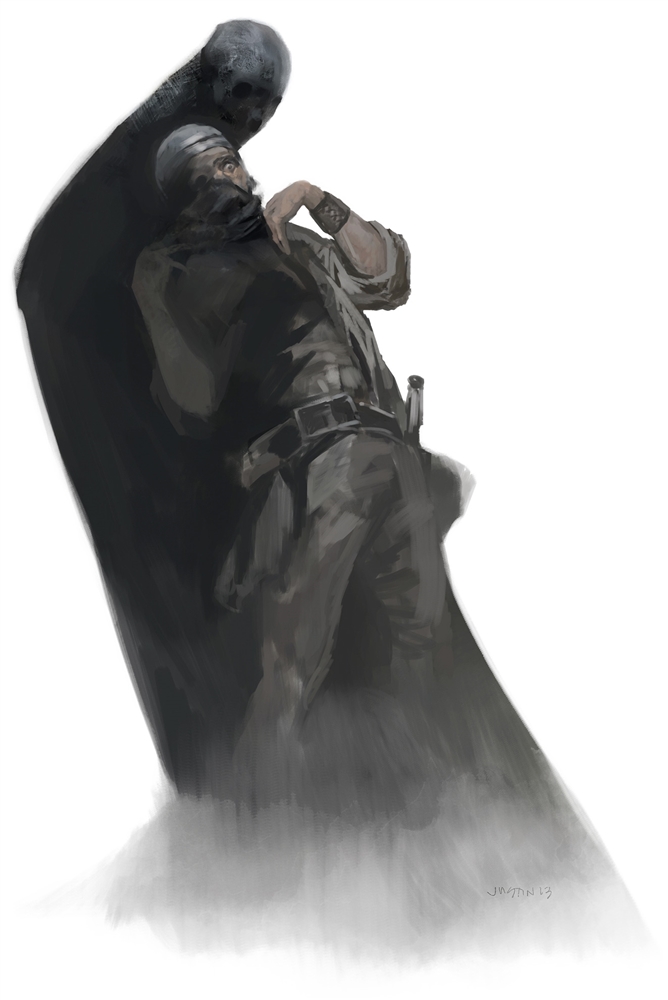
So how did this happen? In this particular case it was three compounding factors.
1. The PCs were overly confident thanks to their high level.
2. The shadows were going to succeed their stealth check to Hide. They were in dim light against a party that relied solely on darkvision. Meaning they had the equivilant of +9 to stealth against the parties 18 passive perception .
3. The PCs were all pretty inexperienced. This was in Adventurers League, which allows you to level up twice for every four hours you play. So in total the four players had around 40 hours of play experience between them.
(The adventure was DDAL08-14 – Rescue from Vanrakdoom by Elisa Teague for those interested. She is a quality adventure author that understands the system and mechanics so this isn’t to call her out at all.)
Each of these factors were clear to me in the moment, but what could the designer of this advenure have done. This adventure was written three years before my party sat down to play so how could any designer account for all of these factors? For my latest adventure I have tried addressing this issue in, what I hope will be, a fun and engaging way.
Enter the ‘Power Alignment Table.’

This simple chart is used in place of a creature listing during an adventure and is designed along two axis, player ability and party size, and is reminiscent of an alignment chart. It works in tandam with CR to create a more customisable experience for each Dungeon Master. To use it, simply design your encounter as normal and place it in the center square. This is our normal (N) difficulty.

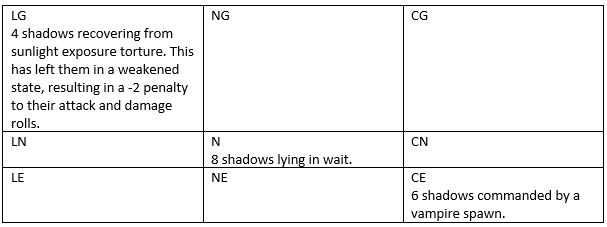
Next, we create a low group, gentle touch (Low-Gentle or LG) encounter in the top left square. This encounter will be for groups that have less than the recommonded number of players and are either inexperienced or prefer social encounters over combat.
Then we create a comprehensive group, experienced players (Comprehensive-Experienced or CE) encounter in the bottom right square. This encounter will be for large groups with experienced or highly tactical players.
Creating a LG and CE encounter may seem difficult at its face, after all we’re essentially creating 3 encounters were there used to be one. But that’s the beauty of this system, because a LG group should not be fighting overly tactical monsters and should have fewer enemies, and a CE group will be the inverse, we only have to apply two changes to our normal encounter to make it work.
LG Adjustments
Lower the enemy number and apply a debuff. A simple rule of thumb to do this is 50% fewer enemies, 50% less deadly. Using the 8 shadows encounter again that would leave us with 50% fewer enemies, which is 4 shadows.
Then we lower damage and hit chance by 50%. A shadow has a +4 to hit and deals 9 hit point damage plus 2 strength damage. We can easily lower this two different ways. We can apply the creatures prexisting weaknesses or apply a ‘story debuff.’
Prexisting Weakness. A shadows sunlight weakness gives it disadvantage on its attack rolls, which is the equivilant of a -5 to its chance of hitting. To reach our 50% less deadly number we want to lower the chance to hit by 2 point and damage by 4 point. So for us, disadvantage is far more impactful than we would want. We also want this method to be universal and most monsters in D&D 5th edition don’t have any weaknesses.
Story Debuff. Our other option is to apply a ‘story debuff.’ Mechanically it is as simple as getting the number we want out. We want a total of +2 to hit, 5-7 hit point damage, and 1 strength damage. So we simply say “This creature lowers its bonus to hit on attacks by -2 and its damage by -2.” This is, however, boring and can frustrate DMs as we just blatently pulled back the curtain and reminded them that these aren’t ‘monsters’ but are instead just collections of number in a box. If we instead say “These shadows have been tortured and exposed to sunlight for hours on end. This has left them in a weakened state, resulting in a -2 penalty to their attack and damage rolls.”
These two methods have the same outcome, a -2 to attacks and damage, but in return it gives players and DMs a deeper sense of verisimilitude. It also invites a change in tactics to the creatures. A hungry, weakened monster is going to act very differently to one at full strength.
CE Adjustments
While the abilties of LG players is somewhat predicatable since most will only be using the core rulebook adjusting for CE groups is significantely more difficult. By their nature, with each new ancestry, class option, spell, feat, or magic weapon released the default power of these PCs is going to increase. So unless you work for the publisher, you’re going to be pretty blind about future options. But, we aren’t writing adventures to be future proof. We are writing a good story first and foremost. So, instead of focusing on numbers we need to focus on tactics.
A baseline increase to difficulty should be 200% of the normal level, though sticking to this dogmatically could cause problems. Using the shadows as an example, if we have 200% of 8 shadows that would be 16 shadows with +8 to hit that deal 18 hit point damage and 5 strength damage. Assuming an average party AC of 20, this means that out of our 16 attacks, 6.4 will hit (40%). This is also an experienced group so choke points which leave our shadows only able to attack 2 or 3 characters is likely. That comes to 32 points of strength damage divide by 3 (10.6) a round. To my knowledge, no character, regardless of how they are built, will survive 3 rounds of that AND we are ignoring critical hits.
All these numbers also leave out an important consideration as well. Tracking the HP and positions of 16 creatures, along with running their turns in an efficient and fun way, is asking quite a lot of a DM. A good rule of thumb is to ensure that there are never more than 8 monsters at once. More than that, and things start to get cluttered at the table very fast (or even worse if you’re using theatre of the mind).
So instead of increasing the number of creatures, lets use stronger base monsters. The XP equivilant for 16 shadows is 6,400. Lets start by reducing the number of shadows to 6. This gives us two more monsters to use and about 5,200xp to spend. Now we just find something more powerful that is thematically appropriate. The ghosts of two victims still haunt this area, a vampire spawn is commanding the shadows for its master, or maybe a pair of ghasts we supercharge with a template are more solid versions of the shadows themselves. Regardless, we now have a much tougher fight while still being fair on both the PCs and the DM.
Now our Power Alignment table looks something like this.
CONCLUSION
Now we simply fill out the remaining slots. CG and LE should look very similar to N with perhaps 1 more or fewer monsters. NG and LN will be almost identical, following the same rules as LG except only 25% weaker. CN and NE will follow suit, except they are 50% more powerful than N.
This means our final table, with slightly better formating will look something like this.

There still needs to be A LOT of fine tuning to make this process smother, and easier for new DMs to understand. Even so, it seems to be a far better option than the current NOTHING that most adventures use or above/below level variations that do show up.


 Roleplaying Writer
Leave a comment