As part of an effort to spotlight tabletop RPGs from my home town I sat down with Mark Beren. Mark is based in Brisbane, Australia and his company, Armoured Gaming, just released their first RPG – KNIGHT. Which is described as a rules lite system with a classic Arthurian/Welsh Fantasy theme.

Interviewer: Mark, it’s a pleasure to speak with you. I guess the first thing people will want to know is how did you develop the ideas you used for the game?
Mark: I suppose in its earliest form it goes back to Traveller, the first (ish) sci fi game, strangely enough, and Ars Magica, a fairly complicated game about magic that involves significant time passing in game – decades or even centuries if you play long enough. For context I’ve been playing and GMing for a long time – probably over 20 years now. At one point I had a regular Tuesday night group, all of which involved were experienced GMs. We’d play different games – board games, card games, short campaigns of things – as something different to our standard fortnightly game with our larger group. This would have been about 2015 or so, I guess.
Anyway, one of the things I was doing at the time was running a Traveller game. If you are unfamiliar, it has a great character creation system where you roll what happens to you as you get older. In that game exactly what happens is fairly loose – you might just get an improvement in piloting ships as much as you might learn espionage. As all three of us were GMs, creating little stories for our characters became pretty normal. At that time the story gaming and OSR movement was already in full swing, but it had passed me by – I’ve never been one to keep up with trends, so I missed the unique designs that were coming out of those movements.
Regardless, a Tuesday night game came along, and in a boring afternoon at work I had this idea of playing 0 level characters in D&D that found their class (eventually) by the time they got to 1st level and broke up the various abilities and statistic improvements in a milestone system. That system is still available for purchase on DM’s guild – just look up Tier Zero Gaming.
But the big thing that came out of that which influenced KNIGHT wasn’t the stripped down 5e. Our first game of this was set in the Forgotten Realms. I had a deep dive into the lore of a place called Tethyr and found an interesting situation of civil war and attacks from these extremist elves in forest to the north. I had the players take over 5 of these 0 level characters each – most of whom died – as levies of a duke fighting against the elves in an abortive attack against the elven forest of the area. Because of situation and circumstance, they rescued the Duke, and were given land and an unpopulated village.
We drew it. We drew little houses and a wood and the little bit of the river where the kids of the town go swimming. We had a little interesting sentence for each little bit. ‘The young people climb these cliffs even though everyone warns them not to. Above is a good view, and no one can see them.’ That sort of thing.
I needed time to pass, and remembering my Ars Magica campaign, remembered that time passing doesn’t ruin anything; it just tells a different story. So, I used the Traveller life path tables as a quick hack to say what happened. We rolled some dice to determine if the word was a good or bad version. And we told a story.
These characters were the heads of the village now. So, when they rolled dependants, it turned out that Big Dan the not-yet-a-fighter had baby girls, so he needed a wife. The gnome tinker rolled something magic which turned into a magical statue that the village people would rub its head for luck, and so on. Then, of course, we had to get back into the questing.
In the first part of the game, we didn’t care if these 0 level nobodies died. But there were suddenly some roots. Some background. Big Dan was on the front line now. But when I played him… I didn’t want him to be. I felt something I hadn’t with other characters – that his two baby girls were waiting for him. I felt a bit of bleed over of emotions between character and person. I thought very hard about how to apply Big Dan. I made choices that kept him safe – or at least, as safe as a big front-line warrior could be, and still protect his friends. Just at the end of this little campaign, at the heady height of level 1, we fought a white dragon wyrmling on a castle wall. It was terrifying, and we used every trick and tactic to avoid death. The emotions were running high. We had stakes, then, that three level one characters on a castle wall would not have had.
In gamers with 20 years’ experience, it’s rare to have to moments of mixed tension and bleed. I wanted to do it again.
So, I discovered that giving little story tips, with some dice randomisation for flavour started to work. I threw a superhero campaign together and we did it again – and it worked, again.
I was on to something. Stories and time. Only from there did I randomly get on to Pendragon from some DrivethruRPG deal. I wrote a few DMs guild things – my pirate campaign, smokepowder rules, my zero-level gaming thing, a whole intro to the Rime of the Frostmaiden campaign. I’d read all the King Arthur myths before – the stories for kids, the Once and Future King, the Mallory stuff – but I’d put it in the back of my mind as one of many inspirational sources. I devoured Pendragon. I loved it. I wanted to run a game in it. I read through the Great Pendragon Campaign. I imagined running it. I finally found story games through Blades in the Dark, and it opened my mind. I found Into the Odd, and Microscope, and the Quiet Year. The idea of a game as a story rather than a simulation, and how rules can affect that – brilliant. I thought hard on my old love of King Arthur and the Pendragon Campaign, and I started to set up for a campaign.
And realised it wouldn’t work, at least not for my group. The rules do some strange loops that partly create a story and are partly just numbers. The campaign itself is a railroad, though not perhaps in the way of most campaigns. Some of the ideas are just antiquated or clinging fiercely to the traditional chauvinistic model. But my biggest problem was its desire to cling to the source material. No matter what you do, you will never be the knights who change the story. You’ll never be Arthur’s advisors. You’ll never get to be on the level of Gawaine or Lancelot.
So, I wrote KNIGHT with that in mind – to keep the knights as first and foremost the main actors in the kingdom. To keep the stories relevant to them. For the rules to assist the narrative and be quick and easy to understand. And most of all, to keep in the little stories of fief and family that ground the fantasy – and make the whole story in many ways more fantastical, more legendary.
I: Well clearly you were correct when you said you were onto something. Your Kickstarter for KNIGHT saw a modest success, easily surpassing its goal and gaining over 200 backers. Considering your company carried no name recognition and the relative isolation of Brisbane, what do you attribute this success to?
M: The greatest help I had at that time was the support of people around me. My gaming group gathered together to assist me at my first convention, and I learned that working with people to talk about KNIGHT wasn’t too hard. On social media I came across a number of wonderful people, and we did some ‘you scratch my back’ sort of work with each other – and from there, supporting me on their own Kickstarter updates. I spent a few hundred on advertising – Facebook seemed the most effective – and probably far too much time building my twitter followers.
I also hit up every person I’ve ever met, so that probably helps as well – and a few of those have quite a level of reach. Being in the Historical European Martial Arts and re-enactment circles in Brisbane didn’t hurt either, as most of those folks are nerds of one stripe or another.
I: The artwork in your book is amazing and really pushes its quality to the next level. Where did you source it from?
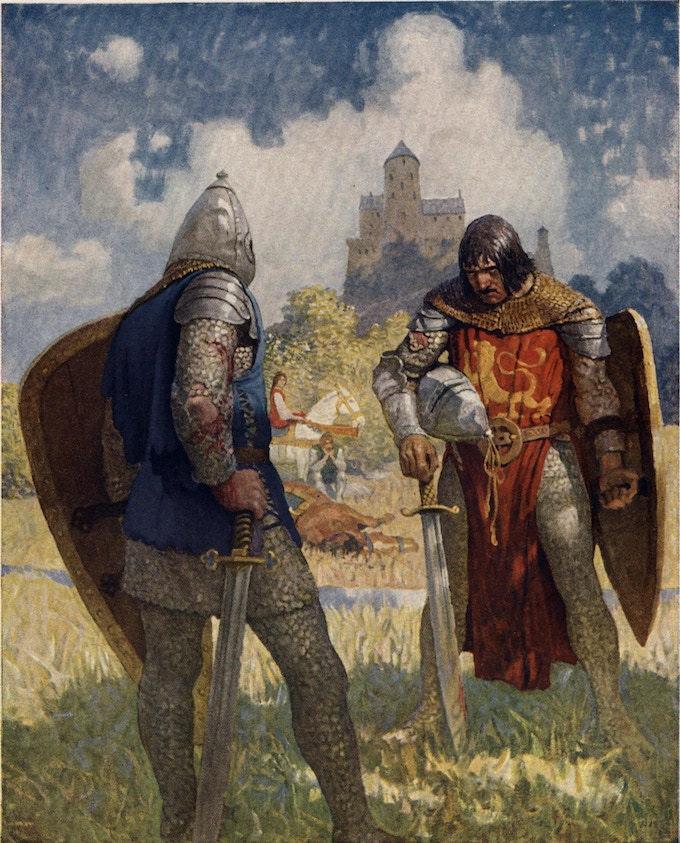
M: The art is all from wiki creative commons. I spent quite a long time searching the internet for art that I could afford (Not a lot!) and what would make a good impression. Eventually I came up to Wiki and being lucky enough that the Victorian painters had a thing for Arthurian mythos was serendipitous. The cover image of Knight is from a fresco painted on a wall in Spain, I believe. I did have some trouble (initially) finding pictures of knightly women, but I did find a few. The second (revised) edition of knight will have a lot more art involved.
I: I’m sure many of our readers are interested in publishing their own work. Are there any words of advice you’d give them?
M: Layout design requires work to learn and understand. I’ve come a long way even since the current printing of KNIGHT. There’s the free program which I initially did KNIGHT in – Scribus – but I’ve since moved to Indesign which is a superior product, though I also hear great things about Affinity. Also, that there is a lot of free art, fonts, and all sorts of stuff available at places like Wikicommons and other places that really get things visually appealing – a google search might net you a lot of interesting results.
I guess also reach out to other designers in the space. I’ve never met people more helpful or thoughtful – and I’ve not received any nastily worded criticism, either. Everyone was genuine in their willingness to help.
I: Aside from your own work do you play other TTRPGs?
M: Absolutely! I’ve recently finished running a few sessions of Cthulhu Dark, my favourite Cthulhu game, and am just about to play my first ever game of FATE – Tachyon Squadron. Highway to the danger zone, baby!
I: And how do you prepare for a session in your home games?
M: I honestly do nothing. I show up to a game, think of whatever incident happened last, where the characters are, and ask them what they want to do next. A GM isn’t a storyteller so much as a conflict moderator; my job is to place narratively appropriate conflict in the way, and then the players handle it from there.
I: The tabletop community has been seeing a boom in rules lite systems, particularly over the past year. Do you think this is the direction the hobby is permanently going?
M: Are things going toward more rules lite? I’d say in the indy scene generally yes – there’s more going on in this space than there is in the crunchy end of the field. Even the crunchiest of modern games are nothing on the simulationist rules that the 90s were big on. With the concept that games (and rules) don’t need to be mapped down to the last iota, it means creators with a vision don’t have to engage in an exhaustive and time-wasting experience of writing rules for stuff they have no need of, and hence, can write and release their games far more easily.
That being said, the indy market is so tiny compared to the big, crunchy giants of D&D and Pathfinder that we rules lite indy designers are just chaff on the wind. I don’t think we make much difference to the hobby as a whole. D&D with all of its crunchy glory is going to dominate and define what RPGs are for the foreseeable future and will continue to release new splatbooks/rules/classes etc until the sun goes out – and most players will be surprised there even are competitors to D&D at all.
Will indy game designers head toward a more rules heavy style? I don’t think so – we have, or are, carving out our little position in the story game/genre game/OSR fields. The niche of big, crunchy, complicated heroic games already has a 500-pound gorilla in it. We tiny indy chimps just hang about on the branches, shrieking about story and playability and actually playing a good game while the gorilla fans itself with money from substandard modules it has written by committee and fed into an AI to sound more human.
I: Speaking of WotC, do you think of the OGL panic that hit the industry at the start of 2023 will have a net positive or negative effect on the indy game scene?
M: My inner cynic says that Wizards can do whatever it likes, and if it loses a few people to rules lite indy games it is a temporary thing at best. Might it bring a few more people to try other games? I hope so! But D&D is in every game store and keeps selling – so unless game stores want to take a stand against Wizards, I doubt anything will change.
I: Lastly, before you go, do you have any future projects we can look forward to seeing on the horizon?
M: I’m looking at doing a re-release of KNIGHT soon, with some additional art, rules clarifications, and expansions for working in a Japanese or late-period Baltic variant. I’m also writing Samurai, but that is still in its early phases – it’s a different rules set. I’m loosely considering a game called Star Fighter, but my early designs for it turned out to crash and burn so it’s back to the drawing board for me.
If you’re interested in picking up a copy of KNIGHT you can get it either digitally or in print here at DriveThruRPG: https://www.drivethrurpg.com/product/432725/KNIGHT
 Roleplaying Writer
Leave a comment