When creating a monster we should have a good idea of what we want players to think about during the fight.
The Medusa turns people to stone with her gaze. Can we turn that into an advantage?
The Dragon breathes fire in a large cone. Don’t group up!
The Intellect Devourer steals bodies. Have they replaced somebody in town?
It’s easy enough to create a new monster and know how we want it to work in our heads, but how do we communicate this information to other GMs? Is it better to give more or less information?

That’s the question I want to talk about today. Should we use a short, tall, or fat stat block?
Firstly what do I mean by each of these. Simply put, short stats give very little mechanical detail, tall stats give basic mechanical detail, and fat stats give full mechanical detail.
To show this in action I’ll present a goblin in each of the three ways.
Here’s a short stat block from D&D Basic. As you can see it gives almost no information. How much health they have, how much damage they deal, what their AC is, their movement speed, their alignment, which treasure table you roll on, any special abilities, two word description of how they act, and a random encounter chance. Honestly, this is all the information we need to provide for 90% of GMs.

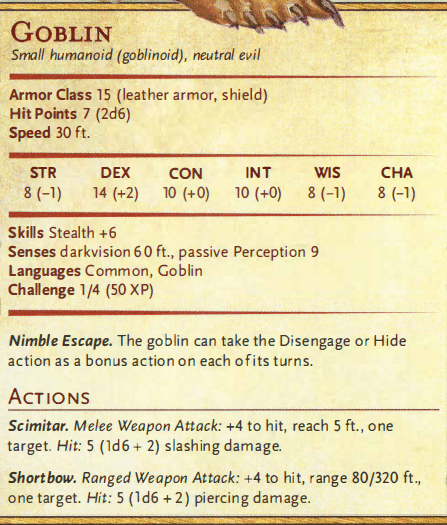
Here’s a tall stat block form D&D 5e. As you can see we get a lot of the same information in this tall stat block as we did with the short one with a few extra pieces. Namely, we have explanations for all of its abilities and how we arrived at the numbers we have. The little information we had about its ecology however is now missing.
And here’s a fat stat block from Pathfinder 1e. This tells us all the same information as the tall stat, plus specifics on which classes the goblin has, all the numbers a GM might need to derive in any situation, and a complete breakdown of equipment and the organisation of a goblin group.

Obviously, these are all from different games with different requirments but they can still be educational in how much information we need to give to a GM.
If I know the method of deriving monster stats in Pathfinder then I can figure out almost all of the information in the fat stat block with nothing but the very little information in the short stat block.
But we shouldn’t expect that of every GM.
In opposite, the tall stat block gives such little information about the monster that without an accompanying ecology article I’d be hopelessly lost on how this monster might think or act, while the short and fat stats offer simple insights on how this monster would live and what treasure they might hold.
There is clearly no ‘best’ way of presenting a monsters information. But I hope this article gets you to consider using shorter monster stats or longer monster stats then is normal for the game you’re writing.
 Roleplaying Writer
Leave a comment