‘Supposed to Lose’ encounters are a simple idea that has been around in games for a long time. These are scenarios where the players are put into a situation that should be impossible to beat. A Kobayashi Maru for our own tables if you will.
While they are usually rare encounters, I have recently played through four such scenarios in the past six months. Once as GM in a prewritten adventure, twice as a player in prewritten adventures, and once as a player in a homebrew game. Knowing this the GM of the most recent example asked me what my opinion on them is and how you can write one well.
So, let’s talk about the three examples I recently experienced in prewritten adventures.
Spoilers for Dungeon of the Mad Mage (2018), The Assimilation Strain (2015), and Assault on the Aerie of the Slave Lords (1981) below.
Both Assimilation Strain and Slave Lords use their supposed to lose fight in very similar ways. They appear right at the end during the final boss fight and they are used to move the characters from one location to another as prisoners for the next adventure in the series. Assimilation Strain uses a gas that slowly debilitates the players during their fight against the boss before eventually knocking them out. The important thing is that they can beat the boss before succumbing to the gas.
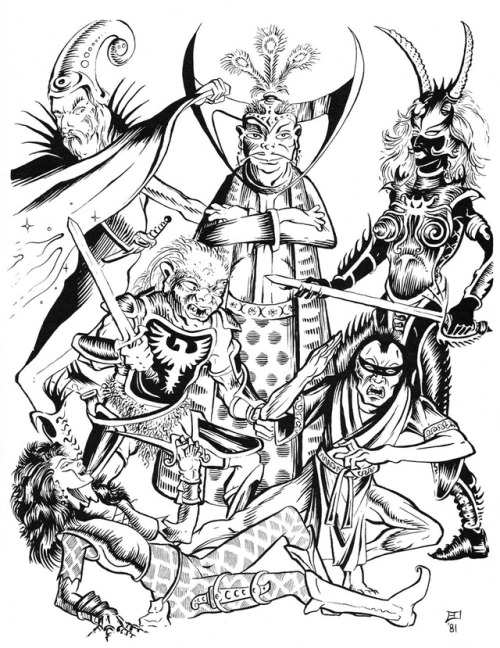
Slave Lords on the other hand offers three different methods. First, the players can fall for a James Bond-esq gas trap that knocks them unconcious as the titular slave lords monologue to them. Second, they can actually fight the slave lords who are WAAAAAAY out of their league (the players are expected to be levels 4-7 while the slavelords range from levels 9-11) and presumably get stomped. Lastly, if they do escape all of that, they have an army of 300 angry guards upstairs ready to stop them.
Mad Mage simply throws a group of level 7 characters into a random fight against a group of Drow in the middle of the third floor that would be difficult for a group of level 10 characters. The characters are then infested with spiders which they’ll need to get rid of within the next 24 hours or they’ll all die. A remove disease will cure them.
If I were to rank each of these methods for which worked out the best I’d put Slave Lords at the top, followed by Assimilation Strain, and last is Mad Mage. But why? I’d say it comes down to two simple ideas. Build-up and meaning.
Build-Up. By having the fight be the final fight we already have the players entering with the assumption of failure being possible. If anyone is going to die it will be here. This means that when things quickly go wrong it can be a little more comforting to find out they are taken alive. This works the best in Slave Lords because, well, the villains are slavers. It makes way more sense that they’ll take you alive then just kill you. In contrast, the Drow in Mad Mage use you as hosts for their spiders even though you still being alive for this process doesn’t really make sense at all. They can achieve the same goals with your dead bodies as they can with you being alive.
Meaning. In this failure there needs to be some kind of reward, usually in the form of information. The fact that the slave lords beat you up, gloated over you, and tortured you for weeks means that you’re ready to kick their asses when the time comes. The supposed to lose situation has added extra meaning to the next fight against these characters. Neither of the other two adventures did this since the Drow who captured you aren’t really the villains. You just happened to walk through the wrong door at the wrong time.
So that’s it. The only real things you need in order for a supposed to lose scenario is for it to have build up and meaning. I will also add in one extra caviate to any DMs planning to run a supposed to lose scenario.
TELL THE PLAYERS!
The worst thing you can do is have a supposed to lose scenario that they waste resources on. If my whole team is struggling, this is the moment I’d pull out the single use scrolls of fireball and potions of raise dead. That means you’ll be punishing players by making them waste irretrievable resources.
 Roleplaying Writer
Leave a comment