When we design a room, dungeon, or world for DMs to read in our adventures we want too ensure it is both easy to understand and memorable. To alleviate some of this I use what is called the three-by-three method.
The three-by-three is simple and can be applied to almost every aspect of a game masters design toolbox. It works by starting at the macro level and going down as small as you would like.
To begin, we figure out the largest part of what we are trying to design. This can be as small as a single room of a dungeon, as big as your games entire universe, or even as specific as the abilities of a single monster. We then divide it into three parts. This could be the three attributes of the room (eg. ornaments, monsters, hazards, treasure, ect.), the three biggest population centers that make up your map (eg. capital cities, small towns, bandit camps, ect.), or your monsters three types of abilities (eg. actions, bonus actions, reactions, ect.).
Now that we’ve divided our design into three segments we just divide that again into three parts and repeat the process. We can continue to do this almost indefinetly depending on how granular you want to get.
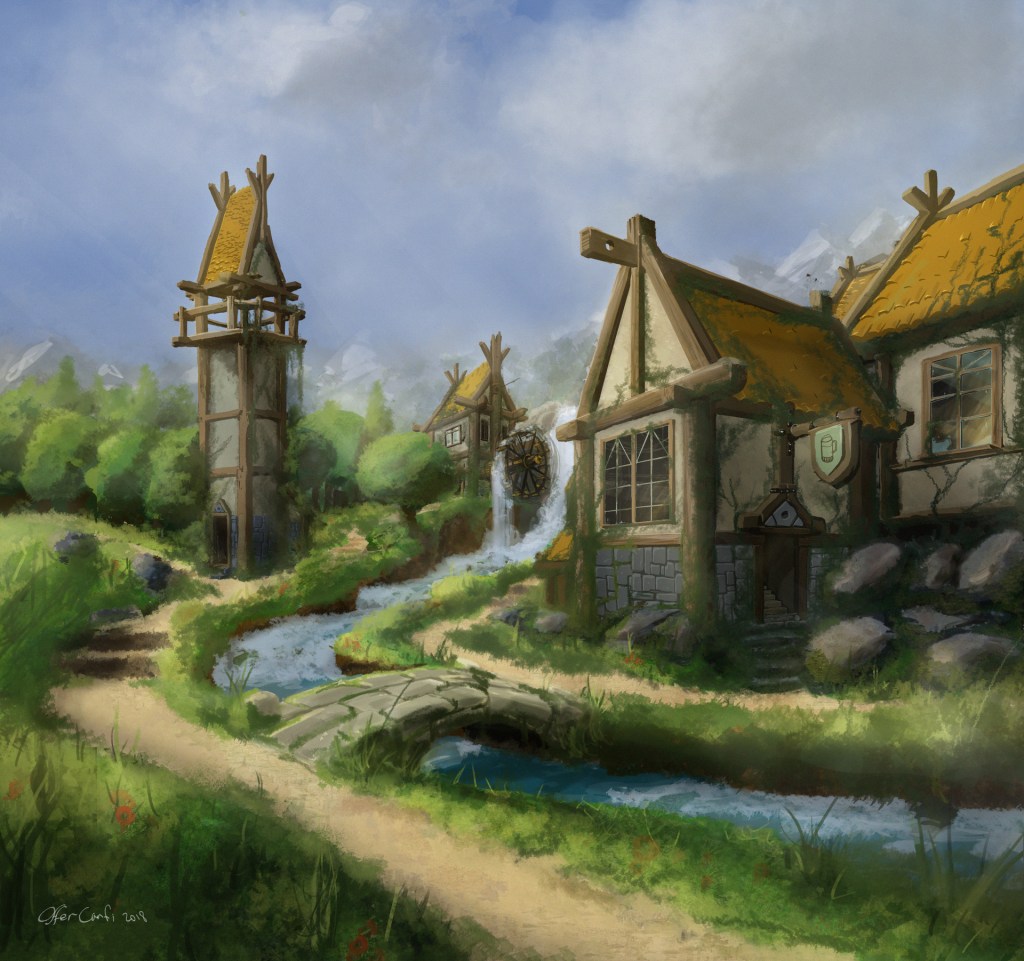
It’s all well and good to talk about design theory, but lets see it in action. I’ll go through my full process of creating a town with you all just to show how quickly you can build a living world with it even at the table.
I decide that this will be small town. My first step is to name it. Since I want this town to be prominently halflings I’ll just look over at my halfling name table and choose two worlds to combine together. You use whatever method is best for your world, whether that’s your own table or a random generator. I’ve decided to go with Little and Bluff, combining them together I’ll create Lilbluff.
Now we need to create three points of interest in Lilbluff. Every good town needs a tavern, I like the idea of a beach where people can relax, and we’ll make the towns main source of income a winery.
Now we’ll need to name each location and give each of them a combination of 3 NPCs or activities.
We’ll name the tavern The Queen’s Armpit. It’ll offer lodging and have 2 NPCs, Arfo Proudear and Vyncent Brythwight.
I’ll name the beach Heaven’s Shore. I’ll put a shipwreck just off shore for PCs to explore, a statue which briefly explains the founding of the town, and an NPC named Marget Grubbins.
Next, the winery will be Burrow’s Vineyard and have three NPCs named Lica Gamtree, Harin Burrowfoot, and Goff Ironhill.
The final step in making this town is to give each NPC three attributes that make them distinct.
Arfo Proudear. Halfling, Male. Proprietor of the Queen’s Armpit, hates elves so he charges them double, and hides his money in the stump of a tree behind his tavern.
Vyncent Bythwight. Human, Male. A drunk that spends most of his time at the Queen’s Armpit, works as a coal burner outside of town, he’s never seen without his trusty dog Otis.
Marget Grubbins. Halfling, Female. An academic that sends most of her days studying at the beach, she has learnt the to cast the cantrip prestidigitation but otherwise has no magical abilities, she wants to study magic in a big city one day.
Lica Gamtree. Halfling, Female. A druid hired to keep the winery safe and fruitful, she is shy and won’t speak unless directly addressed, mostly speaks to plants.
Harin Burrowfoot. Halfling, Male. Owner of Burrow’s Vineyard, desperately tries to emulate sophisticated society, acts like an excited child whenever he sees magic.
Goff Ironhill. Dwarf, Male. A mercenary hired to protect the winery, carries a magical blade which petrifies those it kills, believes a group of cultists is living near to town.
With these locations and NPCs decided we can either run the town as is or go into further detail. We can create descriptive text for each location, decide on a menu for the tavern, or build a dungeon at the shipwreck.
As you can see, with the three-by-three method of design we can create living, believable worlds very quickly and with little to no waste.
 Roleplaying Writer
Leave a comment